


SKU:EE129324
Dental Osseodensification Bur Kit
Dental Osseodensification Bur Kit
Regular price
$799.00 USD
Regular price
Sale price
$799.00 USD
Shipping calculated at checkout.
Quantity
Couldn't load pickup availability
Guaranteed Safe & Secure Checkout
- Free Global Shipping Over $50
- 30 Days Money-back Guarantee
- Secure Shop Payment
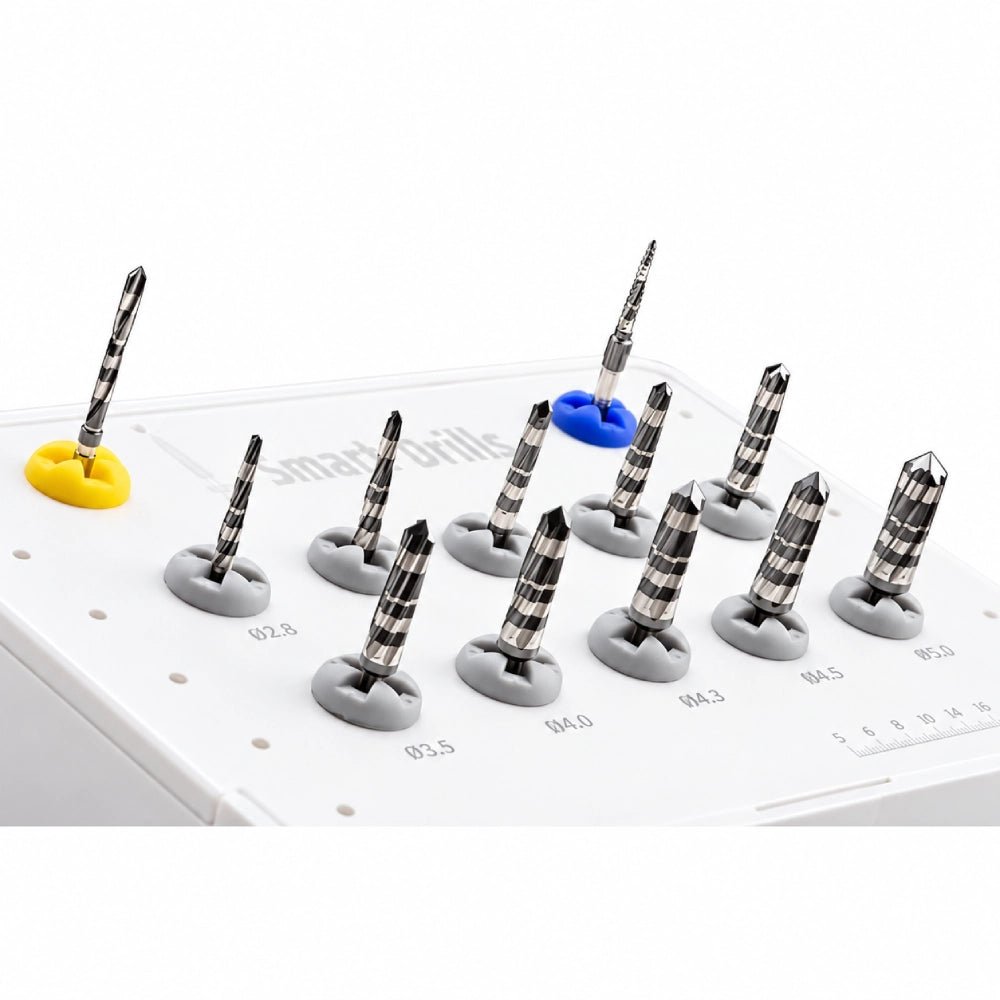
The Smart Dental Osseodensification Bur Kit is a dual-mode implant osteotomy system designed for conventional drilling, bone-compaction preparation, progressive ridge expansion and transcrestal sinus lift procedures.
The system uses a progressive sequence of 12 drills covering preparation sizes from M1.75 to M5.0. Each drill features a tapered geometry with specified apical and coronal diameters for controlled, step-by-step osteotomy preparation. The drills can be operated clockwise for cutting or counterclockwise for bone compaction, allowing the clinician to select the preparation mode according to local bone density and the planned procedure.
Drill Specifications
| Drill | Apical Diameter | Coronal Diameter |
|---|---|---|
| M1.8 | Ø1.0 mm | Ø2.0 mm |
| M1.75 | Ø1.75 mm | — |
| M2.0 | Ø1.3 mm | Ø2.5 mm |
| M2.3 | Ø1.6 mm | Ø2.8 mm |
| M2.5 | Ø2.2 mm | Ø2.8 mm |
| M3.0 | Ø2.3 mm | Ø3.5 mm |
| M3.3 | Ø2.6 mm | Ø3.8 mm |
| M3.5 | Ø3.2 mm | Ø3.85 mm |
| M4.0 | Ø3.4 mm | Ø4.5 mm |
| M4.3 | Ø3.7 mm | Ø4.8 mm |
| M4.5 | Ø3.9 mm | Ø5.0 mm |
| M5.0 | Ø4.4 mm | Ø5.5 mm |
Features
- 12-piece progressive drill sequence
- Sizes from M1.75 to M5.0
- Defined apical and coronal diameters
- Clockwise cutting mode
- Counterclockwise bone-compaction mode
- Tapered geometry for progressive osteotomy expansion
- Designed to preserve more bone during compaction preparation
- Suitable for selected narrow-ridge expansion procedures
- Can be incorporated into transcrestal sinus lift workflows
- Organized surgical case with marked drill positions
- Recommended operating range of 800–1500 rpm
Preserve Bone Through Compaction and Expansion
In conventional osteotomy preparation, bone is primarily removed by the cutting action of the drill.
When the Smart Drill operates counterclockwise, its flute geometry is designed to compact cancellous bone toward the walls of the osteotomy. The surrounding trabecular bone undergoes controlled lateral deformation, allowing progressive expansion of the prepared site while limiting conventional bone removal.
This bone-compaction mechanism is designed to:
- Preserve bone within and around the prepared implant site
- Compact cancellous bone along the osteotomy walls
- Create a progressively wider osteotomy
- Utilize the elasticity of trabecular bone during ridge expansion
- Support implant-site preparation in lower-density bone
- Increase bone contact around the prepared osteotomy

Clockwise Cutting and Counterclockwise Compaction
Clockwise Cutting Mode
Clockwise rotation allows the drill to cut bone and progressively prepare the implant osteotomy.
Recommended speed: 800–1500 rpm
This mode may be selected for conventional preparation and areas with denser cortical bone.
Counterclockwise Bone-Compaction Mode
Counterclockwise rotation changes the drill from conventional cutting to bone-compaction preparation.
Instead of primarily removing bone, the drill applies pressure toward the surrounding cancellous bone, producing a denser layer along the osteotomy walls.
Recommended speed: 800–1500 rpm
Adequate irrigation and a controlled pumping motion should be used according to the manufacturer’s surgical protocol.

Progressive Ridge Expansion
The tapered drill sequence gradually increases both the apical and coronal dimensions of the osteotomy.
During counterclockwise operation, lateral pressure causes the surrounding cancellous bone to deform outward. This allows suitable narrow ridges to be expanded progressively while preserving more of the existing alveolar bone than a purely subtractive drilling sequence.
The technique is intended for bone with sufficient elasticity and is generally not suitable for expansion of Type I dense cortical bone.
Potential applications include:
- Narrow alveolar ridge preparation
- Progressive osteotomy expansion
- Implant-site preparation in cancellous bone
- Preparation of sites with reduced ridge width
- Selected immediate implant-placement procedures

Transcrestal Sinus Lift Application
The Smart Drill can be incorporated into a transcrestal sinus lift workflow in appropriately selected posterior maxillary cases.
As the drill approaches the sinus floor in counterclockwise mode, bone at the base of the osteotomy can be advanced apically. This supports controlled elevation through the crestal approach without routine malleting.
In selected cases, a transcrestal approach may reduce the need for a lateral-window sinus lift. This depends on residual bone height, sinus anatomy, the required elevation and the clinician’s assessment.
The drill design does not eliminate the risk of sinus membrane perforation. Preoperative CBCT evaluation and controlled depth preparation remain necessary, especially around sinus septa and irregular sinus-floor anatomy.

Applications
- Conventional dental implant osteotomy preparation
- Bone-compaction osteotomy preparation
- Implant-site preparation in lower-density cancellous bone
- Progressive expansion of suitable narrow alveolar ridges
- Transcrestal sinus-floor elevation
- Selected immediate implant-placement procedures
FAQ
How does the bone-compaction mode preserve bone?
When operated counterclockwise, the drill is designed to compact cancellous bone toward the osteotomy walls instead of primarily removing it as drilling debris.
How does the kit expand a narrow ridge?
The tapered drills are used progressively. Their increasing apical and coronal diameters apply controlled lateral pressure to cancellous bone, allowing the osteotomy and surrounding ridge to expand gradually.
Does bone compaction increase primary stability?
Bone compaction is intended to create a denser layer around the prepared osteotomy, which may support primary implant stability. Actual stability depends on bone quality, implant geometry, osteotomy preparation and clinical conditions.
Does the system increase BIC?
The compaction mechanism is designed to retain and compact bone around the osteotomy, potentially increasing available bone-to-implant contact. A specific BIC improvement cannot be guaranteed for every clinical case.
Can this kit replace a lateral sinus lift?
Not in every case. In appropriately selected cases, it may support a transcrestal sinus lift and reduce the need for a lateral-window approach. The decision depends on residual bone height, required elevation and sinus anatomy.
Can it be used around sinus septa?
The system may assist preparation around irregular sinus-floor anatomy, but sinus septa must still be identified by CBCT and included in the surgical plan. “No need to avoid septa” should not be treated as an absolute safety claim.
Is this a Versah Densah Bur Kit?
No. This is an independently manufactured Smart bone-condensing drill system and is not manufactured by, affiliated with or endorsed by Versah.

Collections
-

GBR Instruments
Professional GBR instruments and accessories, including tenting screws, mesh membranes, and bone...
-

Instruments
Dental instruments designed for diagnosis, clinical procedures, and daily practice across periodontal,...
-
implantology
Includes dental implants with their corresponding abutments and accessories, as well as...


